Art as Investigative Research | Nicolas Malevé: Fugitive Images of an Aging Society
Visual artist and data activist Nicolas Malevé is interested in the socio-technical networks of artificial intelligence and their cultural implications. He is currently a postdoc researcher at Sciences Po’s School of Law and Medialab (Paris). In his work he is experimenting with techniques to engage with large collections of visual materials and explore different ways to navigate and question them.
Nicolas Malevé about
Fugitive images of an ageing society
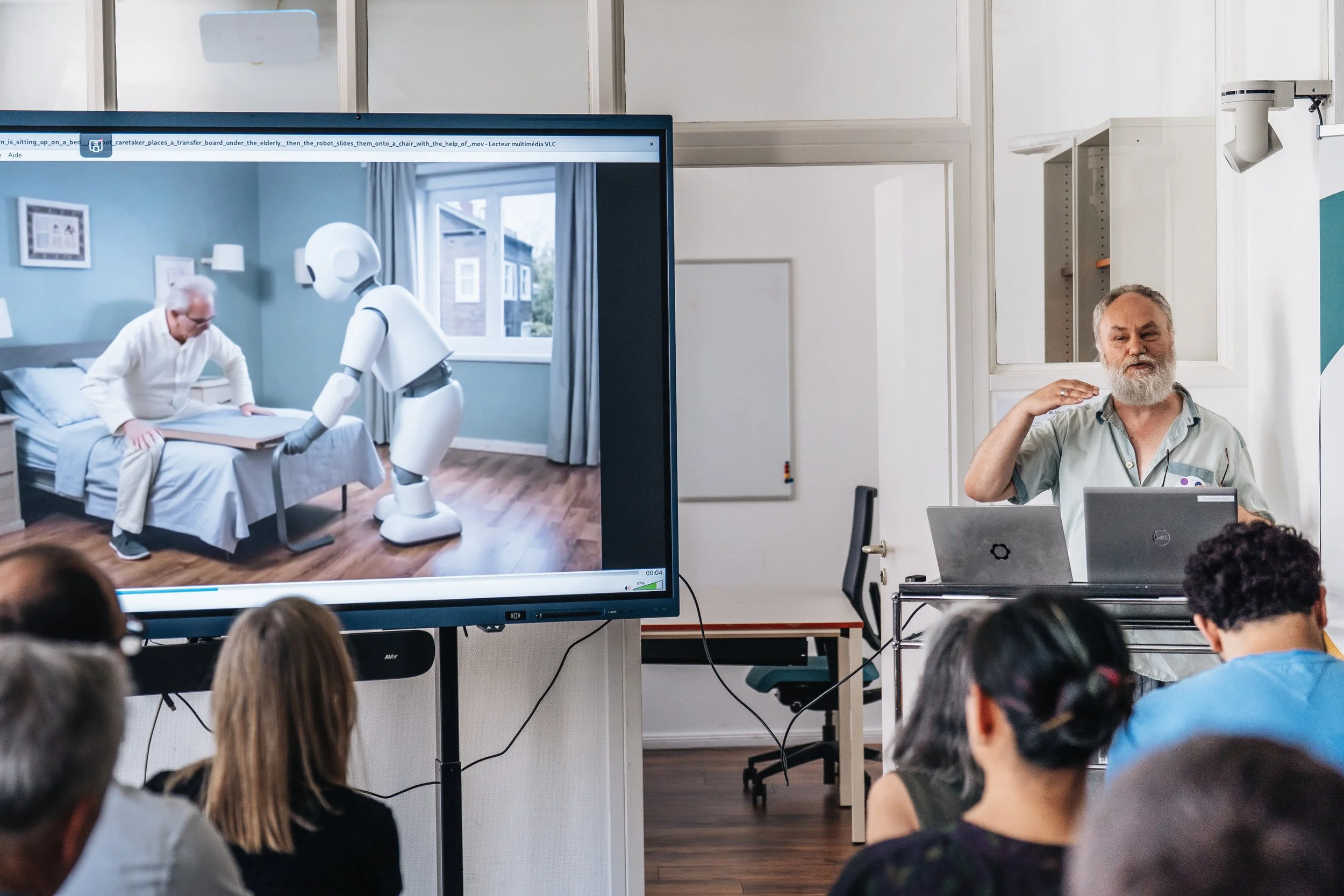
When I was invited to think about migration in an ageing society, I immediately thought about a series of gestures I had observed when my father was in a care home. The caretakers, several of them having recently migrated, mastered a technique to help him in and out of bed. They were placing a transfer board under my father, then slid him onto a chair with the help of a gait belt. With this image in mind, I started prompting an AI video generator to see whether it would be able to reproduce this sequence of movement. As I expected, the results were off. Obviously, the model had not been trained for this purpose. But they were interesting. Instead of representing the rigidity of the ageing body, the model was producing short clips where the man on the bed and the caretaker were absorbed in a game whose rules were not immediately apparent. Intrigued by the output and the newly found agility of the old man in the sequence, I added to my prompt the request that the characters defy gravity. Which, to my delight, they did. Adding to the sequences a slightly odd mix of background music ranging from muzac to cinematic suspense sound effects.
‘Helping Hands’
Video showcase (draft, work in progress) for the Future Lab #1 BERLIN
Copyleft Nicolas Malevé, 2026
Model: LTX (LightTricks) run locally with Draw Things.
As the workshop to which I was invited raised the increasing automation of jobs currently performed by humans, I asked the model to generate a sequence where a robot had taken the role of the caretaker. Another surprise awaited me. This time, the model reversed the roles: the old man was taking care of the ageing robot. These videos are first attempts to find my way into the potential relations of an ageing body, those who help them and the lurking future of automation. These images are as disturbing as they are surprising. Disturbing because they elude the relations of power inherent to the situation and because they do not register the aching pain and the agony of being bed-ridden. But they also offer a glimpse into a moment of suspension where the participants in the scene defy the rules that hold them in place.
What will the future of care work look like?
Who will care for whom?
What will machines really need to learn in order to care for the elderly?
These are first excerpts from Nicolas Malevé’s experiments with AI-generated images, exploring how worldviews from the past can be reconfigured - or not - into visions for the future.
What becomes apparent in these images?
What can and cannot yet be visualized?
How do you think caregiving will have evolved and changed by the year 2050?
A short interview with Nicolas Malevé
on the occasion of the 1st Future Lab in Berlin, June 2026
Nicolas, would you see yourself more as a researcher or more as an artist?
Nicolas Malevé: I think we all have both in us, right? I must say that I become more of an artist when I'm with researchers. The opposite is true, too.
When I was an art student, I felt really frustrated by the fact that we were treated like ‘You artists you do great things, but you don’t have to think’ … and I had the impression: Well, but I want to live a full life!
Art is less conditioned to delivering an answer and or formulating things explicitly, so I think you can work on issues, problems, sensations and experiences for much longer at the level where they are not really explicit but remain very ambiguous. They do not fully explain themselves, and this is considered a virtue. This is very different from research, where ambiguity is present but expected to be resolved at the end. In art, it's OK for things to remain opaque.
Where do you see the blind spots in purely data-driven visions of the future?
Data is always partial and always corresponds to a particular worldview. Data reflects ideologies. We can work as much as we want to make that clear or limit its effects. But there is no such thing as pure data.
If you look at image models, which are of particular interest to me, you will find that they are trained using extensive data sets that have been downloaded from the internet. There are also different ways in which images and texts are paired. Sometimes people are paid very little to describe or tag images. The labor conditions are so poor and the pay is so low that they have to work super-fast. So, in a sense, we already bias the data through the means of production in the first place.
You were part of the working group on the “Automated Republic” scenario—what current parallels do you see between the present and this future scenario?
Well, this scenario is based on the idea that power will be held by those who control technology. One way they will control society is by automating and replacing human labor. As more and more crucial tasks in society are performed by machines, agents, robots and so on, those who own them will have more direct control over society. It's a real fear, and if you read the newspaper today, you'll see it everywhere. It has a very plausible basis in the sense that we have seen it in the US, China and increasingly in Europe as well. It's clear to see how the Trump administration's alliance with big tech is adverse to democratic values, and things might go in that direction. So, in a way, it's not very surprising because that's really the dominant narrative.
What struck you as particularly questionable, thinking more deeply about a world where automation rules?
If we want to achieve anything like the automation scenario suggests, this would require a disproportionate amount of investment. All the necessary capital to achieve this level of automation would be concentrated in the US as it is where the financial infrastructure is for this amount of capital to be raised. This is a territorial question as well. The necessary material infrastructure in terms of data centers would require a lot of space and land would be appropriated for that purpose.
What I find interesting and worrying about this scenario is how it presumes that resources will be available. What about energy? Is there really enough energy to make that scenario plausible? Do we have enough on the planet? Would we have to go into space? This scenario is a dark fantasy but it inspires real politics.
Which aspects of the connections between migration, aging societies, and automation would you find interesting to explore further?
The application of this scenario in real life would likely be uneven. A likely challenge for those who would implement it would be to reconsider what we currently take for granted in terms of strategic sectors and needed skills, both of which would probably need to be redefined. What will happen between sectors that are fully automated and those that are not?
Automation will be limited and probably concentrated in certain sectors. So how will the cards be redistributed along these lines? This is quite interesting because, on the one hand, it's scary because there will be people who will obviously lose their jobs. There will probably be sectors where human relations will deteriorate, but there will also be other dynamics where that doesn't happen.
In our scenario group, we particularly focused on the impacts on the aging population, which is probably the area that concerns me the most because it's a population that will be most vulnerable to these changes and will probably have less ability to fight back.
But much of our thinking about the world stems from being confronted with issues that are never fully resolved - it's also what makes the richness of the world. This is why we must continue to try to understand, resist and imagine different futures.